


When ADIA Lab and Crunch Lab launched the Causal Discovery Challenge, the ambition was clear: bring the global data science community together to tackle one of the hardest problems in applied machine learning. The challenge needed participants to infer causality from observational data.
During these three months, ~2000 crunchers worked with 25,000 datasets and submitted over 3500 models with a single goal: discover why variables relate, not just how.
Why Causal Discovery?
Understanding causality is a core challenge for any discipline that involves decision-making under uncertainty. In fields like healthcare or finance, randomized control trials (RCTs) are the gold standard for causal inference and are often impossible or unethical to conduct.
That’s where causal discovery comes in:
Instead of starting with a hypothesis about casual links, it starts with data and works backward to uncover the underlying graph of causal relationships. Participants faced 25,000 observational datasets, each hiding a distinct causal structure.
To aid crunchers, a separate training set of 25,000 datasets with known causal graphs was provided. This approach mirrors how institutions can apply differential privacy principles by sharing synthetic or anonymized datasets to fuel advanced modeling without risking exposure of sensitive or proprietary data. The scale dwarfed previous efforts in the causal discovery space and required participants to move beyond standard out-of-the-box algorithms.
Lets take a look at the top 10 exceptional winners of the ADIA Lab Causal Discovery Challenge 👇
Top 10 Winners: From Academia to Industry
First Place: Hicham Hallak

A neural network-based approach, remarkably applying convolutional neural networks (CNNs), more commonly used in image recognition, to causal discovery.
Hicham is an engineer from École Centrale, Master’s from Telecom Paris Tech, with over 10 years in recommender systems and customer segmentation. Despite never working in causality before, Hicham successfully transferred methods from recommender systems into causal graph discovery. His use of CNNs introduced a surprising and highly effective solution.
Read more about Hicham’s winning solution:
2nd Place: André Franca, PhD & Alexis Gassmann
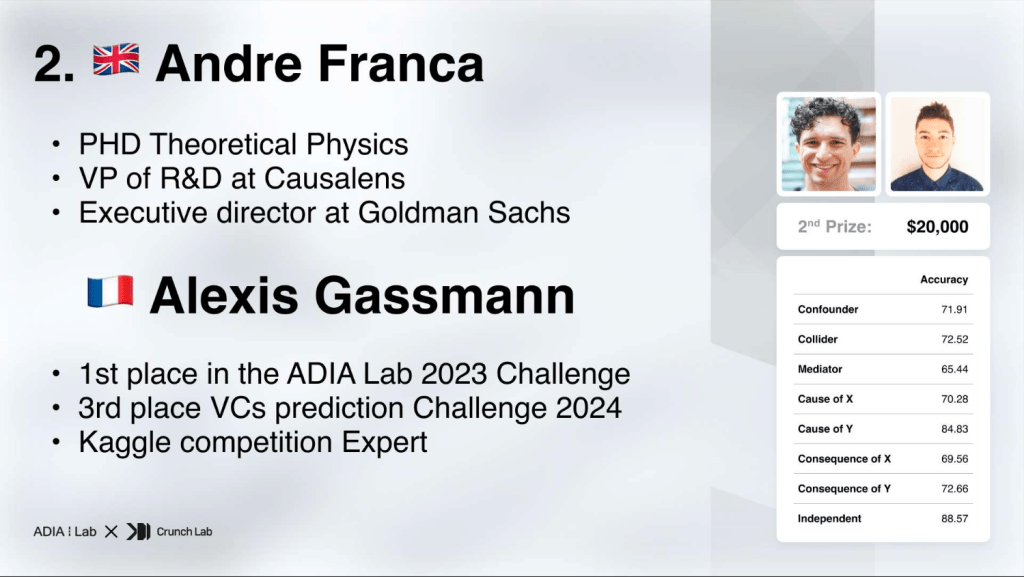
An ensemble combining modified PC algorithms, non-linear conditional independence tests, and a variational autoencoder for deep learning. Balanced interpretability and performance
André holds a PhD in theoretical physics and founded ErgodicAI. Alexis is a CrunchDAO member and data scientist.
They demonstrated a creative blend of classical causal discovery with cutting-edge deep learning. A rare, interdisciplinary approach that outperformed many conventional methods.
3rd Place: ShanghaiTech & Xiamen University Team

A hybrid approach using neural networks combined with statistical testing to improve causal structure prediction.
MuTian Hong (Undergraduate, Computer Science, ShanghaiTech University) & Guoqin Gu (Financial Engineering student, Xiamen University).
Young researchers who competed at the highest level. Their model balanced advanced techniques with computational efficiency, showcasing the next generation’s potential.
Read more about their winning solution:
4th Place: Alexander Kiechle-Cornish
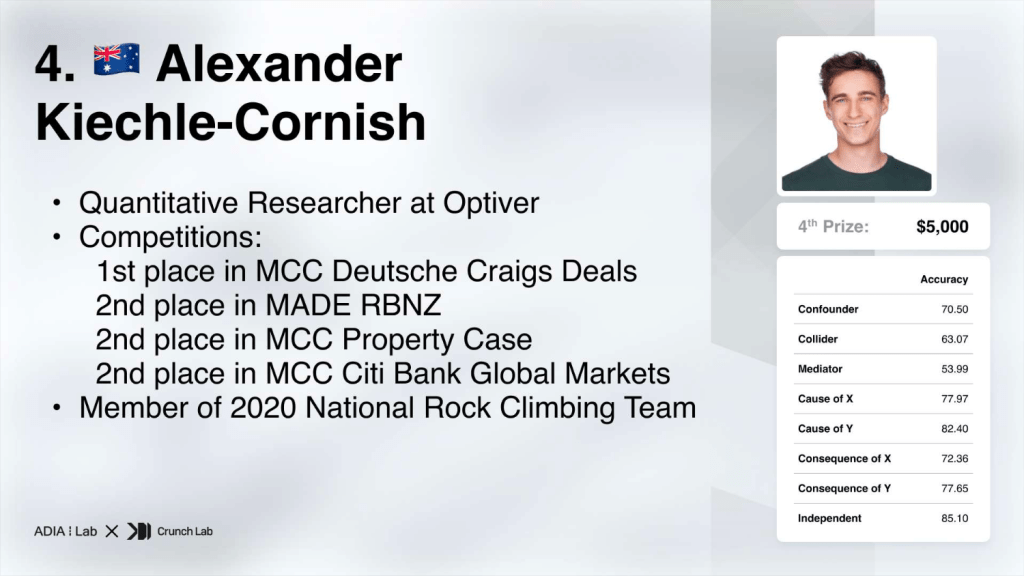
Alexander, Quantitative researcher at Optiver Global applied robust statistical testing techniques adapted for high-dimensional data reflecting real-world trading conditions.
Alexander’s deep understanding of quantitative finance shone through in how he designed his model to avoid overfitting while staying responsive to complex data.
Read more about their winning solution:
5th Place: Nu Hoang
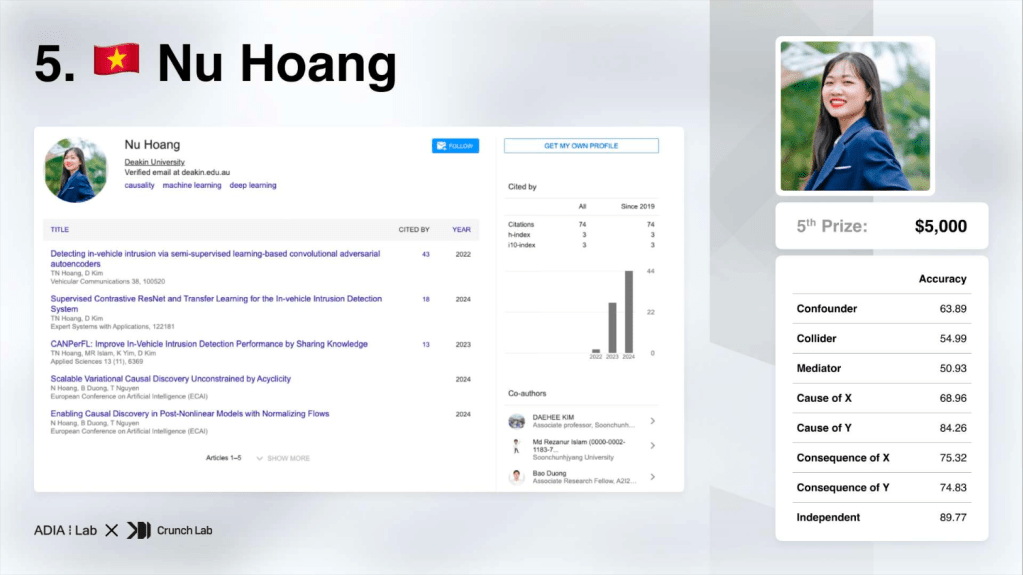
Developed a hybrid architecture combining supervised learning with constraint-based causal inference methods.
Nu is a Causal research-focused student at Deakin University. Nu’s blend of theoretical and practical techniques showed creativity, especially impressive considering her early academic stage.
Read more about their winning solution:
6th Place: Jorge Linde Díaz
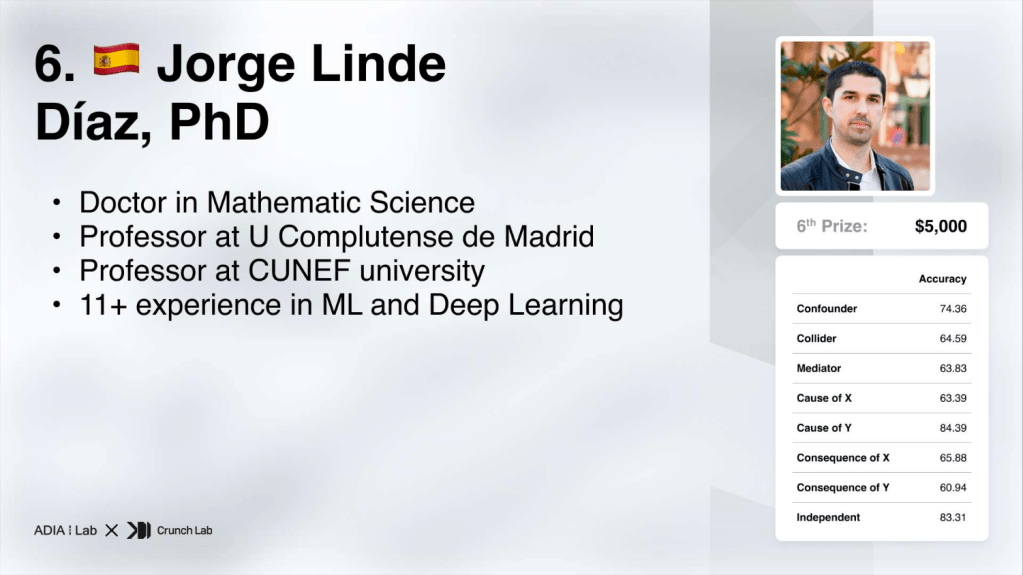
Applied signal processing techniques (uncommon in causal discovery) to enhance feature extraction and improve graph predictions.
Jorge is a Senior Data Scientist (Indra Company), Image Processing Lead, University Professor at CUNEF, Doctor in Mathematical Science.
His cross-domain thinking brought tools from image and signal processing into causal inference, yielding robust results.
7th Place: Bao Duong
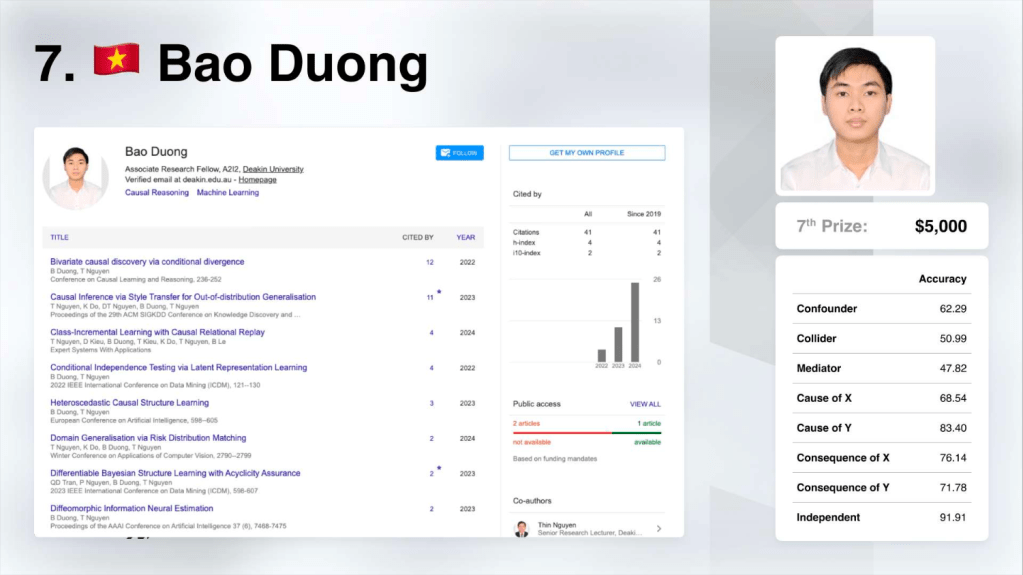
Integrated ensemble models combining rule-based methods with machine learning predictors.
An Associate Research Fellow, A2I2, Deakin University, Bao demonstrated how combining multiple modeling paradigms can enhance accuracy without excessive computational complexity.
8th Place: Grzegorz Tratkowski, PhD
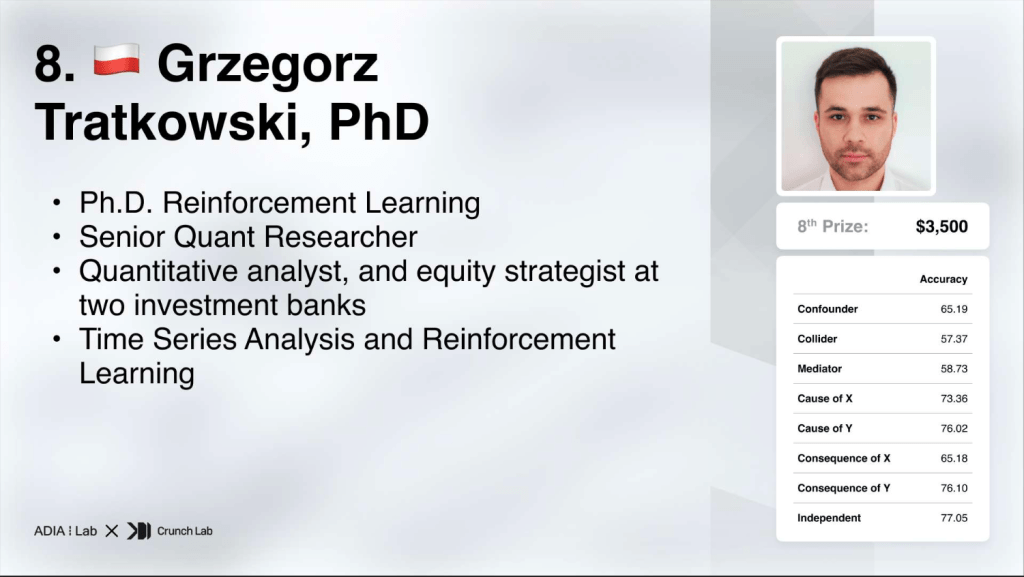
Built a model leveraging reinforcement learning principles for adaptive graph structure evaluation.
Grzegorz, a PhD in reinforcement learning, Senior Quant Researcher at OANDA, brought together his quant finance experience and RL knowledge, an unusual and effective combination.
9th Place: Quang-Duy Tran
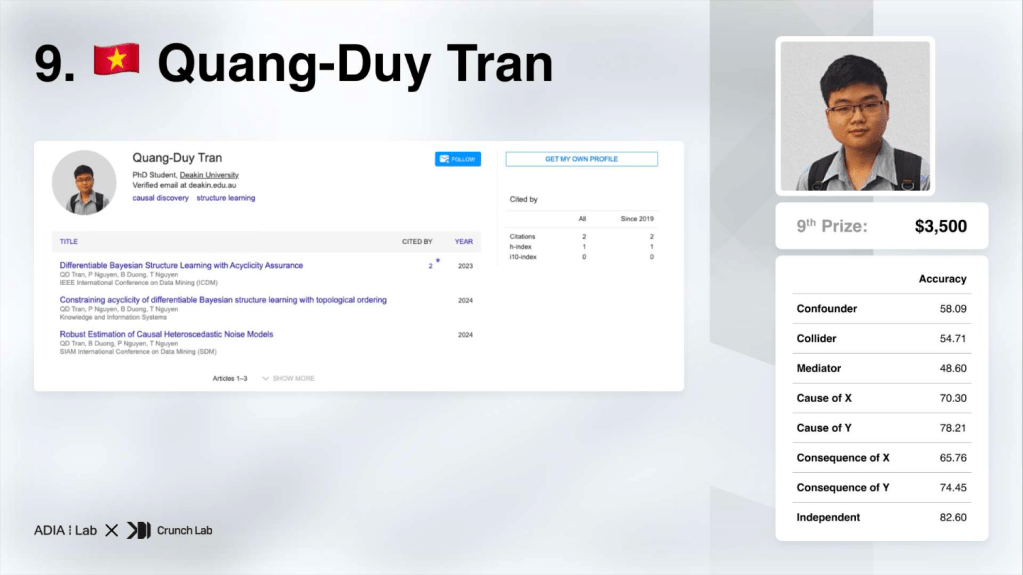
Developed a machine learning pipeline optimized for scalability across thousands of datasets.
PhD Student, Deakin University. Quang-Duy focused not just on accuracy but also on computational efficiency, a key for real-world applicability.
10th Place: Thin Nguyen, PhD
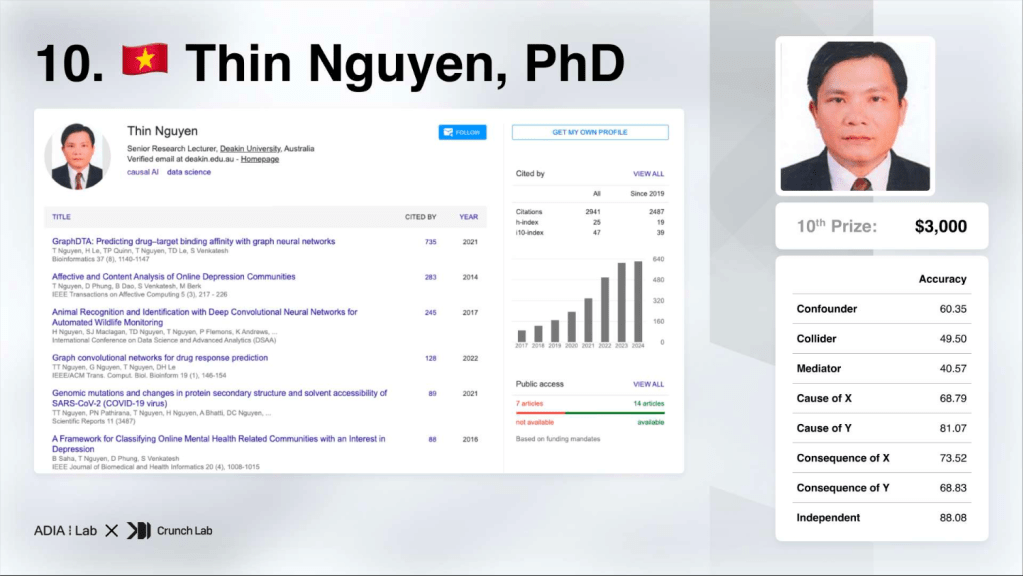
Combined classical statistical techniques with modern machine learning for robust causal graph prediction.
Thin, Senior Research Lecturer, Deakin University demonstrated the value of blending established theory with new methods, creating a balanced, reliable model.
Looking Ahead
A new ADIA Lab x Crunch challenge is on the horizon—continuing our tradition of tackling complex, high-impact problems at the intersection of data science, finance, and real-world change.
As Jean Herelle summarized:
“The world doesn’t reward models that fit the past. It rewards those that adapt to the future.”
> Stay tuned for the next challenge → crunchdao.com
> Join the community
 CrunchDAO